


Perhaps it happens while drifting over a reef near Nosy Tanikely, scanning for colour among the coral, when a broad shell materialises below you. Perhaps it is on the pale sweep of Nosy Iranja, where tracks in the sand hint at nighttime journeys you did not witness. Or perhaps it is a fleeting silhouette rising for air in a mangrove channel at sunset, gone as quickly as it appeared. To be in the company of turtles is to enter a new, gentle world of exploration.
From Time + Tide Tsara Komba, the surrounding waters of north west Madagascar offer remarkable opportunities to encounter sea turtles in their natural habitat.

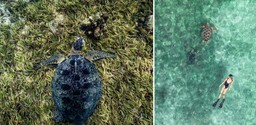
The most commonly sighted species in this region is the green sea turtle, known scientifically as Chelonia mydas. Despite the name, its shell ranges from olive to deep brown, often patterned with beautiful, radiating markings.
Green turtles are herbivores as adults, and much of their day is spent grazing peacefully on seagrass beds and algae. Around Nosy Komba and neighbouring islands, you may find them feeding in shallow lagoons, completely absorbed in their task. They rise regularly to breathe, lifting their heads briefly out of the water before sinking down again.
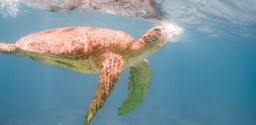
On snorkelling trips to Nosy Tanikely, a protected marine reserve, it is not unusual to see green turtles gliding over coral slopes. Here, visibility is often excellent, and you can observe their effortless movement — almost flight — powered by slow, sweeping strokes of their front flippers. They are curious without being intrusive, and if you remain calm and respectful, they may continue feeding or swimming just metres away.
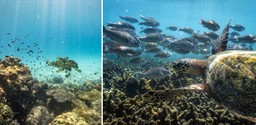
Less frequently seen but equally captivating is the hawksbill turtle, Eretmochelys imbricata. Recognisable by its narrow, pointed beak and intricately patterned shell, the hawksbill is often associated with vibrant coral reefs.
Hawksbills are primarily spongivores, meaning they feed on sea sponges, delicately extracting them from reef crevices. When diving around reef systems near Nosy Iranja or Nosy Sakatia, you may spot one manoeuvring with surprising agility between coral towers. Compared to green turtles, hawksbills often appear more intent and focused, pausing to inspect a particular section of reef before taking a careful bite. Because hawksbills are critically endangered, every sighting feels particularly special.
Observing one in the wild is a reminder of both the fragility and resilience of these ecosystems.
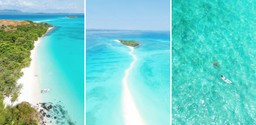
Certain islands in the archipelago, especially Nosy Iranja, are known nesting sites. During nesting season, females haul themselves ashore at night to lay their eggs above the high tide line. By day, you might see the telltale tracks etched into the sand, wide flipper marks leading from sea to dune and back again.
If you are exceptionally fortunate and visiting at the right time of year, you may witness hatchlings making their first determined journey to the ocean. It is a brief and moving spectacle, one that underscores the vulnerability of early life and the instinct that has guided turtles for millions of years.
On a mangrove sunset cruise, the focus may be on birds and shifting light, but turtles are occasionally seen surfacing in the sheltered channels. Juveniles, in particular, use mangrove systems as nursery grounds, where calm waters offer protection from larger predators.
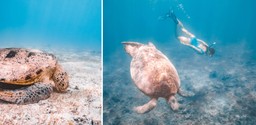
Being in the company of turtles comes with responsibility. One must move slowly and keep a respectful distance. Never touch or block their path to the surface. By floating calmly and allowing them to choose their course, you become an unobtrusive witness rather than a disturbance.
To share the ocean with a turtle is to feel the scale of it all. The distances travelled. The seasons navigated. The instinct that draws them back to these shores again and again. Each sighting feels remarkable: the filtered light, the slow rhythm of flippers, and the sense that, for a few suspended moments, you were in sync with the sea.
Book your sustainable adventure with us
travel@timeandtideafrica.com
- Share:


